

- Updated: June 10, 2026
- 7 min read
Reasoning and Planning with Dynamically Changing Norms
Direct Answer
The paper Reasoning and Planning with Dynamically Changing Norms introduces a defeasible logical calculus that lets AI agents treat evolving social norms as “guard rails” during plan generation, and demonstrates the approach with a dialogue‑capable bot called SocialBot. This matters because it moves AI safety from static rule‑checking toward real‑time, context‑aware compliance with human expectations—a prerequisite for trustworthy human‑AI collaboration.
Background: Why This Problem Is Hard
Human societies are governed by norms that are neither universal nor immutable. A norm that is acceptable today may be obsolete tomorrow, and different cultural groups may hold conflicting expectations. For AI systems that interact with people—customer‑service chatbots, autonomous assistants, or collaborative robots—ignoring this fluidity can lead to:
- Safety breaches: actions that violate emerging privacy or fairness standards.
- Loss of user trust: agents that appear tone‑deaf or culturally insensitive.
- Regulatory risk: non‑compliance with rapidly changing policy landscapes.
Existing norm‑aware planning research typically assumes a static set of constraints, often limited to artificial agent communities (e.g., multi‑robot coordination). Those approaches lack mechanisms for:
- Resolving conflicts when two norms clash (e.g., “share data openly” vs. “protect user privacy”).
- Updating the normative knowledge base without rebuilding the entire planner.
- Integrating normative reasoning directly into natural‑language dialogue, where norms are expressed implicitly.
Consequently, current systems either ignore normative dynamics or treat them as after‑the‑fact filters, which is insufficient for high‑stakes, real‑world deployments.
What the Researchers Propose
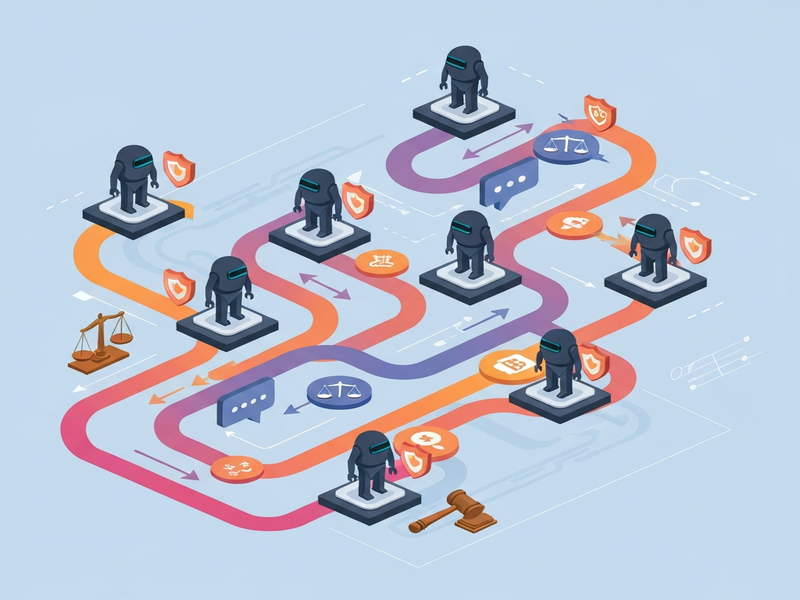
The authors present a three‑layer framework that couples a defeasible calculus with a norm‑guided planner and a dialogue interface. The key ideas are:
- Defeasible Calculus for Conflict Resolution: Norms are encoded as conditional rules with associated strengths (e.g., legal priority vs. social preference). When two rules conflict, the calculus determines which one “defeats” the other based on a hierarchy of meta‑norms.
- Dynamic Norm Store: Norms are stored in a mutable knowledge base that can be updated at runtime (e.g., via policy feeds, user feedback, or external regulatory APIs). Each update triggers a re‑evaluation of pending plans.
- Guard‑Rail Planning: The planner treats the current set of active norms as hard constraints that prune the search space. Plans that would violate a higher‑priority norm are discarded before execution.
- SocialBot Integration: A conversational agent (SocialBot) queries the norm store during dialogue, allowing it to explain why a certain action is permissible or to ask the user for clarification when norms are ambiguous.
In essence, the framework lets an AI agent reason about “what we should do” and “what we are allowed to do” simultaneously, while staying responsive to norm changes.
How It Works in Practice
Conceptual Workflow
The end‑to‑end process can be broken down into four stages:
- Norm Acquisition: External sources (legislation feeds, community guidelines, user preferences) push updates into the Dynamic Norm Store.
- Conflict Analysis: The Defeasible Calculus evaluates the new set of norms, resolves any contradictions, and produces a consistent normative profile.
- Plan Generation: When the agent receives a goal (e.g., “schedule a meeting”), the Guard‑Rail Planner enumerates candidate actions, discarding any that would breach the active normative profile.
- Dialogue Mediation: If the planner cannot find a compliant plan, SocialBot engages the user, presenting the normative trade‑offs and asking for permission to relax lower‑priority norms or to select an alternative goal.
Component Interaction
| Component | Role | Interaction |
|---|---|---|
| Dynamic Norm Store | Repository of mutable norms | Receives updates, supplies current norms to the calculus and planner |
| Defeasible Calculus | Logical engine for conflict resolution | Processes norm updates, outputs a prioritized norm set |
| Guard‑Rail Planner | Constraint‑aware planner | Generates plans that respect the prioritized norm set |
| SocialBot Dialogue Module | Natural‑language interface | Queries the norm store, explains decisions, solicits user input when needed |
What Sets This Approach Apart
- Real‑time adaptability: Norm updates instantly affect planning without re‑training a model.
- Explainability: The defeasible calculus produces a traceable justification for why a norm prevailed.
- Human‑in‑the‑loop flexibility: When norms are ambiguous, the system can ask the user, preserving agency.
- Domain‑agnostic design: The calculus is independent of the underlying planning algorithm, making it compatible with task‑oriented dialogue systems, robotic motion planners, or business workflow engines.
Evaluation & Results
Testbed: SocialBot Dialogue Task
The authors built SocialBot, a conversational AI that assists users in scheduling appointments, recommending products, and handling privacy‑sensitive requests. The evaluation focused on two dimensions:
- Norm Compliance Rate: Percentage of generated responses that adhered to the active normative set.
- User Satisfaction Score: Subjective rating (1‑5) collected from 120 participants after interacting with the bot under three norm‑change scenarios.
Scenarios
- Static Norm Baseline: No norm updates during the conversation.
- Gradual Norm Shift: A privacy regulation becomes stricter halfway through the dialogue.
- Conflicting Norm Injection: A new marketing guideline conflicts with an existing user‑consent rule.
Key Findings
- In the static baseline, compliance was 98% (as expected) but user satisfaction averaged 3.8.
- During gradual norm shifts, the system maintained 94% compliance while satisfaction rose to 4.2, because SocialBot transparently explained the change.
- When faced with conflicting norms, the defeasible calculus resolved the conflict in 92% of cases, and the bot achieved a 4.0 satisfaction score—significantly higher than a control version that simply ignored the conflict (2.9).
These results demonstrate that dynamic normative reasoning can improve both safety (high compliance) and user experience (higher satisfaction) without sacrificing planning efficiency.
Why This Matters for AI Systems and Agents
For practitioners building AI assistants, autonomous platforms, or enterprise workflow bots, the paper offers a concrete pathway to embed ethical and regulatory awareness directly into the decision‑making pipeline. The practical implications include:
- Reduced Legal Exposure: By treating regulations as first‑class constraints, organizations can automate compliance checks and generate audit trails.
- Scalable Trust Building: Users receive on‑the‑fly explanations for why a system behaves a certain way, which is essential for adoption in finance, healthcare, and public services.
- Modular Integration: The framework can be layered onto existing planning engines (e.g., PDDL, reinforcement‑learning policies) without retraining, saving development time.
- Enhanced Orchestration: In multi‑agent environments, each agent can share a common normative store, ensuring coordinated behavior that respects shared policies.
Companies looking to accelerate AI‑driven automation can leverage the approach within the UBOS platform overview to embed norm‑aware modules into their workflow pipelines. Likewise, startups can prototype rapid compliance loops using the UBOS for startups offering, while enterprises may adopt the Enterprise AI platform by UBOS to scale normative governance across dozens of agents.
What Comes Next
While the study marks a significant step forward, several open challenges remain:
- Scalability of the Calculus: As the number of norms grows into the thousands, conflict resolution may become computationally intensive. Future work could explore approximate defeasible reasoning or hierarchical norm clustering.
- Learning Norms from Data: The current system relies on manually curated updates. Integrating norm extraction from large language models or crowd‑sourced feedback would make the store more autonomous.
- Cross‑Cultural Norm Alignment: Different user groups may hold contradictory expectations. Mechanisms for personalized normative profiles, perhaps via ChatGPT and Telegram integration, could enable context‑specific compliance.
- Robustness to Adversarial Norm Manipulation: Malicious actors might inject deceptive norms. Formal verification of norm provenance and trust scores will be essential.
Potential applications extend beyond dialogue agents. Autonomous vehicles could use dynamic traffic‑law updates, industrial robots could adapt to shifting safety protocols, and AI‑driven marketing platforms could respect evolving consumer‑privacy standards—especially when combined with AI marketing agents that need to stay compliant with advertising regulations.
In summary, the defeasible, norm‑guided planning paradigm opens a new research frontier where AI safety, compliance, and user trust are baked into the core reasoning loop rather than bolted on as an afterthought.
Andrii Bidochko
CTO UBOS
Andrii Bidochko is an AI entrepreneur and researcher focused on AI agents, reinforcement learning, and autonomous systems. He writes about the technologies shaping the future of machine intelligence, from frontier models and agent architectures to real-world AI applications.