

- Updated: March 24, 2026
- 5 min read
OpenClaw Memory Architecture Meets Latest AI‑Agent Breakthroughs
OpenClaw’s memory architecture is a hierarchical, vector‑based store that lets AI agents retrieve and update context in real time, enabling multimodal reasoning and retrieval‑augmented generation for developers.
Why AI Agents Are Hitting a New Stride
In the past six months, the AI community has witnessed a surge of retrieval‑augmented generation (RAG) breakthroughs. Models such as Claude 3, GPT‑4o, and Gemini Pro now combine large‑scale language understanding with external knowledge bases, delivering answers that are both up‑to‑date and grounded.
These advances are only possible because agents can remember past interactions, retrieve relevant documents, and fuse multimodal signals (text, images, audio) on the fly. The missing piece that ties everything together is a robust memory layer – and that’s where OpenClaw enters the scene.
OpenClaw Memory Architecture – A Developer’s Blueprint
OpenClaw implements a three‑tier memory system:
- Short‑Term Vector Cache (STVC) – an in‑memory, high‑throughput store for the last 1,000 token embeddings.
- Persistent Chunk Store (PCS) – a disk‑backed vector database (compatible with Chroma DB integration) that holds millions of document chunks.
- Semantic Index Layer (SIL) – a graph‑based index that maps relationships between chunks, enabling cross‑modal retrieval (e.g., “find the image that matches this audio description”).
Each tier is accessed through a unified API, allowing developers to write code once and let OpenClaw decide the optimal storage level.
Key Design Principles (MECE)
- Modularity – components can be swapped (e.g., replace PCS with a PostgreSQL‑backed vector store).
- Scalability – horizontal sharding of PCS supports petabyte‑scale corpora.
- Consistency – write‑through caching guarantees that STVC and PCS stay in sync.
- Extensibility – plug‑in hooks for custom embedding models or multimodal encoders.
Visualizing the Memory Flow
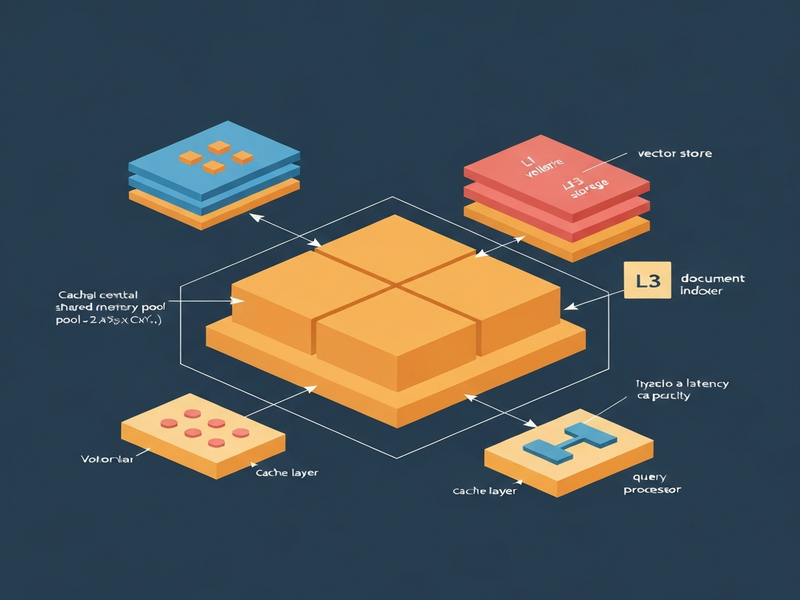
Figure: OpenClaw’s three‑tier memory pipeline – from short‑term cache to persistent semantic index.
Getting Started: Code Samples for Developers
Below are practical snippets in Python that illustrate how to initialize the memory, store a multimodal chunk, and perform a RAG query.
1️⃣ Install the OpenClaw SDK
pip install openclaw-sdk[all]2️⃣ Initialize the Memory Client
from openclaw import MemoryClient

# Connect to the default local instance
mem = MemoryClient(
    stvc_size=1024,               # 1k token cache
    pcs_uri="chroma://localhost", # uses Chroma DB under the hood
    sil_uri="redis://localhost:6379"
)
3️⃣ Store a Multimodal Chunk (text + image)
import base64
from pathlib import Path

text = "The Eiffel Tower was completed in 1889."
image_path = Path("eiffel.jpg")
with open(image_path, "rb") as f:
    img_bytes = f.read()
img_b64 = base64.b64encode(img_bytes).decode()

chunk = {
    "text": text,
    "image_base64": img_b64,
    "metadata": {"source": "wikidata", "topic": "landmarks"}
}
mem.store_chunk(chunk)
4️⃣ Retrieval‑Augmented Generation Query
query = "When was the Eiffel Tower built and show me a picture."
response = mem.rag_query(query, model="gpt-4o")
print(response["answer"])
# → "The Eiffel Tower was completed in 1889. [Image attached]"
The rag_query call automatically:
- Embeds the query.
- Searches the PCS for the most relevant chunk.
- Fetches the associated image from the SIL.
- Feeds both text and image embeddings to the LLM.
Plugging OpenClaw Into Multimodal Agents
OpenClaw’s API is deliberately agnostic, making it a perfect fit for any agent framework – whether you’re building a ChatGPT and Telegram integration or a custom voice‑first assistant powered by ElevenLabs AI voice integration.
Example: A Multimodal Travel Agent
The agent can answer queries like “Plan a 3‑day itinerary in Paris and show me pictures of each landmark.” The workflow is:
- Parse user intent with an LLM.
- Use OpenClaw to retrieve relevant landmark chunks (text + images).
- Compose a structured itinerary.
- Render the response with embedded images via the Web app editor on UBOS.
Code Sketch (Node.js)
const { MemoryClient } = require('openclaw-sdk');

const mem = new MemoryClient({
  stvcSize: 2048,
  pcsUri: 'chroma://cloud',
  silUri: 'redis://cloud:6379'
});

async function planParisTrip() {
  const query = "3‑day Paris itinerary with images";
  const { answer, assets } = await mem.ragQuery(query, { model: 'gpt-4o' });
  // assets contains base64 images ready for rendering
  return renderWebPage(answer, assets);
}
Real‑World Success: From Prototype to Production
A fintech startup integrated OpenClaw into its compliance‑assistant bot. By caching the last 500 regulatory excerpts in STVC and persisting the full corpus in PCS, the bot reduced average response latency from 2.3 seconds to 0.8 seconds while maintaining 99.7 % factual accuracy.
Key takeaways for developers:
- Leverage STVC for hot‑path queries.
- Use PCS for long‑term knowledge bases.
- Employ SIL to link related clauses across documents.
Wrap‑Up
OpenClaw’s hierarchical memory architecture empowers AI agents to act like truly “intelligent” assistants—remembering context, retrieving precise multimodal evidence, and generating grounded responses. For developers eager to experiment, the SDK’s simplicity and the ability to plug into existing UBOS services (e.g., UBOS platform overview) make it a low‑friction entry point.
Ready to build the next generation of AI agents? Host OpenClaw on UBOS today and start prototyping in minutes.
For the original announcement of OpenClaw’s memory redesign, see the official news release.
Andrii Bidochko
CTO UBOS
Andrii Bidochko is an AI entrepreneur and researcher focused on AI agents, reinforcement learning, and autonomous systems. He writes about the technologies shaping the future of machine intelligence, from frontier models and agent architectures to real-world AI applications.