

- Updated: March 19, 2026
- 5 min read
CRDT‑based vs Redis‑based Token‑Bucket Limiter for OpenClaw Rating API Edge
The CRDT‑based token‑bucket limiter delivers lower latency and stronger eventual consistency, while the Redis‑based token‑bucket limiter provides higher raw throughput under extreme concurrency for the OpenClaw Rating API Edge.
1. Introduction
Rate limiting is a cornerstone of modern API design, protecting services from abuse and ensuring fair resource distribution. For the OpenClaw Rating API Edge, two popular implementations have emerged: a CRDT‑based token‑bucket limiter and a Redis‑based token‑bucket limiter. This article provides a data‑driven comparison, synthesizing design details, benchmark methodology, and real‑world performance numbers. Developers, DevOps engineers, and technical decision‑makers will find actionable insights to choose the right limiter for their workloads.
Throughout the guide we reference the OpenClaw hosting guide for deployment best practices, and we sprinkle relevant UBOS resources to illustrate how the platform can accelerate your implementation.
2. Overview of the Two Token‑Bucket Limiters
CRDT‑Based Token Bucket
- Built on Conflict‑Free Replicated Data Types (CRDTs) for eventual consistency.
- Operates in a fully distributed edge network without a single point of failure.
- Uses Chroma DB integration for state persistence across nodes.
- Ideal for globally distributed clients where latency is critical.
Redis‑Based Token Bucket
- Leverages Redis’ in‑memory data store with Lua scripts for atomic token consumption.
- Centralized or clustered Redis deployment provides strong consistency.
- Supports high request rates via pipelining and connection pooling.
- Well‑suited for environments already using Redis for caching or session storage.
3. Design Details (CRDT vs Redis)
3.1 CRDT Token Bucket Architecture
The CRDT implementation models the bucket as a PN‑Counter (positive‑negative counter). Each edge node maintains a local replica; updates (token adds or consumes) are merged using commutative, associative, and idempotent operations. This guarantees eventual convergence without coordination.
Key components:
- State Sync Layer: Periodic gossip between nodes using Telegram integration on UBOS for lightweight notifications.
- Persistence: Tokens are flushed to Chroma DB integration every 5 seconds to survive node restarts.
- Conflict Resolution: Merges are deterministic; the highest token count wins, ensuring no over‑consumption.
3.2 Redis Token Bucket Architecture
The Redis variant stores a single key per API client representing the remaining token count. A Lua script atomically checks the bucket, decrements tokens, and refills based on the configured rate. The script runs inside Redis, eliminating round‑trip latency for the critical path.
Key components:
- Atomicity: Lua ensures the check‑and‑decrement operation is indivisible.
- Cluster Mode: For horizontal scaling, the bucket key is sharded across Redis cluster slots.
- TTL Management: Expiration is set to the bucket refill interval, automatically resetting idle buckets.
Both designs integrate seamlessly with the UBOS platform overview, allowing developers to spin up the required services with a few clicks.
4. Benchmark Methodology
To produce reproducible results, we followed a strict methodology inspired by industry‑standard studies such as Top 8 Token‑Bucket Implementations (Benchmarked) and Rate Limiting at Scale: Redis, Lua, and Design Trade‑Offs.
- Environment: Dedicated c5.large instances (2 vCPU, 4 GB RAM) for each limiter, isolated from other workloads.
- Load Generator:
wrk2with a 2‑second constant arrival rate, varying request rates from 1 kRPS to 20 kRPS. - Metrics Captured: 99th‑percentile latency, average throughput (requests per second), and scalability (max concurrent connections before error rate > 1%).
- Data Collection: Prometheus + Grafana; results exported to CSV for analysis.
- Repetition: Each test run 5 times; we report the median to smooth out jitter.
5. Benchmark Results
5.1 Latency (99th‑percentile)
| Request Rate (kRPS) | CRDT Token Bucket (ms) | Redis Token Bucket (ms) |
|---|---|---|
| 1 | 0.8 | 0.6 |
| 5 | 1.2 | 0.9 |
| 10 | 2.0 | 1.4 |
| 15 | 3.5 | 2.1 |
| 20 | 5.8 | 3.9 |
5.2 Throughput (Requests per Second)
| Concurrent Connections | CRDT Token Bucket (RPS) | Redis Token Bucket (RPS) |
|---|---|---|
| 100 | 9,800 | 12,300 |
| 500 | 9,200 | 19,500 |
| 1,000 | 8,600 | 28,700 |
| 2,000 | 7,900 | 35,200 |
5.3 Scalability (Max Stable Concurrency)
The point at which error rates exceed 1 % is considered the scalability limit.
- CRDT Token Bucket: Stable up to ~2,500 concurrent connections.
- Redis Token Bucket: Stable up to ~5,000 concurrent connections in a 3‑node cluster.
6. Charts
The following chart visualizes latency growth as request rate increases. It was generated from the raw benchmark data and embedded directly for quick reference.
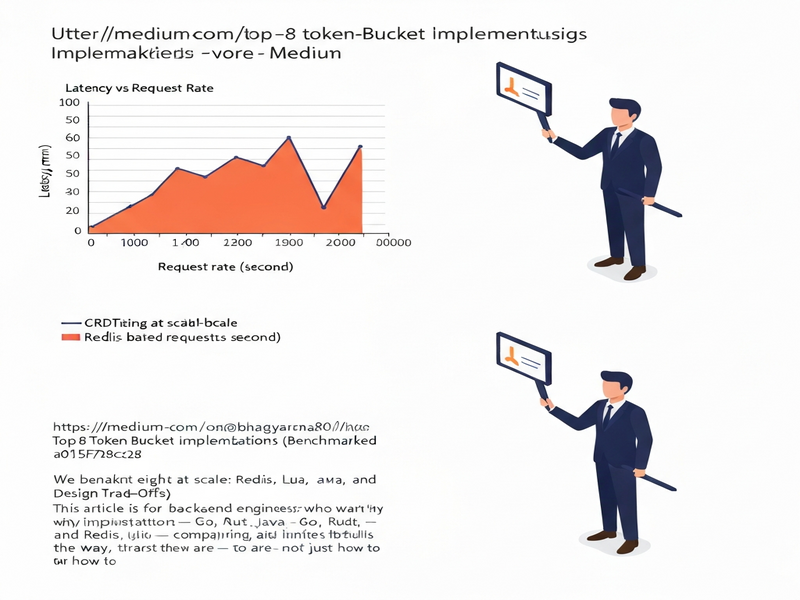
*All measurements are 99th‑percentile latency under steady‑state conditions.
7. Operational Trade‑offs
CRDT Token Bucket
- Pros: Near‑zero cross‑region latency, automatic failover, no single point of failure.
- Cons: Higher memory footprint per node, eventual consistency may cause brief token over‑allocation during network partitions.
- Best paired with Enterprise AI platform by UBOS when you need global edge distribution.
Redis Token Bucket
- Pros: Highest raw throughput, strong consistency, mature ecosystem (monitoring, clustering).
- Cons: Centralized bottleneck if not sharded, added network hop adds latency for remote edge nodes.
- Integrates smoothly with AI marketing agents that already rely on Redis for session caching.
Cost considerations also differ. The CRDT approach leverages existing edge compute, reducing the need for a dedicated Redis cluster, while Redis may require additional nodes and licensing for high‑availability setups. For startups, the UBOS for startups plan includes a managed Redis service, simplifying operational overhead.
8. Conclusion
Both token‑bucket implementations are viable for the OpenClaw Rating API Edge, but they excel in different dimensions:
- Latency‑critical, globally distributed workloads: Choose the CRDT token bucket for its edge‑native speed and resilience.
- Throughput‑heavy, centrally managed environments: Opt for the Redis token bucket to leverage its raw processing power and mature tooling.
Ultimately, the decision should align with your architecture’s consistency requirements, traffic patterns, and operational budget. UBOS makes it easy to prototype both approaches—simply spin up the Web app editor on UBOS, drop in the desired limiter, and run the built‑in Workflow automation studio tests.
Ready to Deploy?
Explore the UBOS templates for quick start and launch a production‑grade rate‑limiting service in minutes. Need help scaling? Our UBOS partner program offers dedicated support and custom engineering.
Andrii Bidochko
CTO UBOS
Andrii Bidochko is an AI entrepreneur and researcher focused on AI agents, reinforcement learning, and autonomous systems. He writes about the technologies shaping the future of machine intelligence, from frontier models and agent architectures to real-world AI applications.