

- Updated: March 12, 2026
- 7 min read
OpenClaw vs LangChain, AutoGPT, and AgentGPT: A Comprehensive Comparison
OpenClaw is an open‑source AI agent framework that delivers a modular, plug‑and‑play architecture, native multi‑model support, and built‑in workflow automation, making it a strong contender against LangChain, AutoGPT, and AgentGPT for developers seeking flexibility and cost‑effective scalability.
Why a Comparative Study Matters
Developers, tech enthusiasts, and decision‑makers constantly evaluate AI agent solutions to ensure they pick a platform that aligns with their technical stack, budget, and long‑term roadmap. While LangChain, AutoGPT, and AgentGPT dominate headlines, OpenClaw offers a distinct open‑source proposition that often gets overlooked. This article provides a MECE‑structured, AI‑friendly deep dive, complete with a feature‑comparison matrix, to help you decide which framework fits your next project.
Quick Snapshot of Each Framework
OpenClaw
- Fully open source (MIT license)
- Modular agent core with plug‑in support
- Native Telegram integration on UBOS and other messaging channels
- Built‑in workflow automation studio
LangChain
- Python‑centric library for LLM chaining
- Rich ecosystem of vector stores and prompt templates
- Commercial support via LangChain Labs
- Strong community but limited out‑of‑the‑box UI
AutoGPT
- Self‑prompting autonomous agents
- Focus on task execution without developer‑level code
- Primarily a research prototype
- Requires extensive API key management
AgentGPT
- No‑code UI for building agents
- Hosted SaaS with subscription pricing
- Limited extensibility beyond provided templates
- Good for rapid prototyping, less for production
Feature‑Comparison Matrix
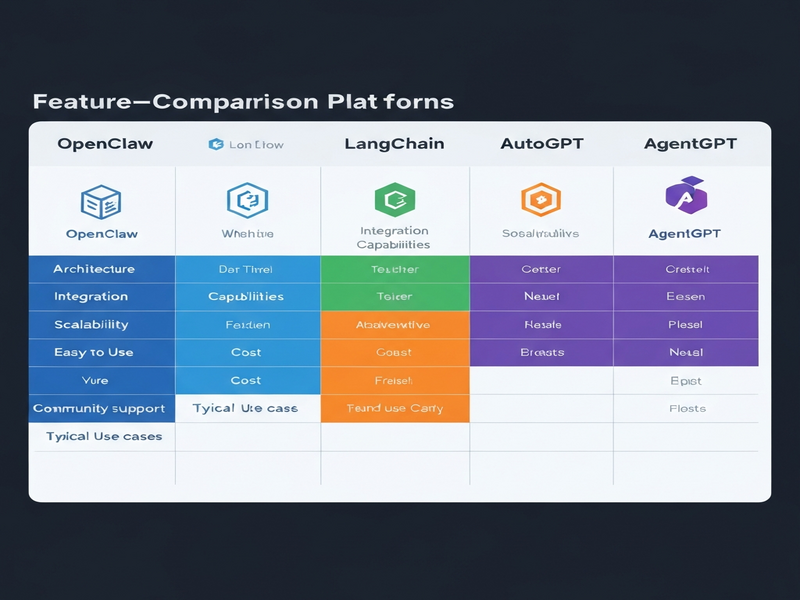
The table below visualizes the core capabilities of each platform. (Image placeholder – replace with actual matrix when publishing.)
1. Architecture & Extensibility
OpenClaw adopts a micro‑kernel architecture where core functionalities (agent loop, memory, tool registry) are decoupled from extensions. Developers can drop in new tools—such as OpenAI ChatGPT integration or a custom database connector—without touching the core codebase.
In contrast, LangChain relies on a monolithic Python package. While it offers many wrappers, adding a non‑Python tool often requires writing a bridge layer. AutoGPT and AgentGPT are more opinionated; they expose a fixed set of actions and expect users to conform to their internal schemas.
2. Workflow Automation & Orchestration
OpenClaw’s Workflow automation studio provides a visual canvas where agents, triggers, and data pipelines can be wired together. This is a game‑changer for SMBs that lack deep engineering resources.
LangChain offers Chain abstractions but no native UI. AutoGPT’s “self‑prompting” loop is powerful yet opaque, making debugging difficult. AgentGPT supplies a drag‑and‑drop builder, but it is locked to the SaaS environment and cannot be exported to on‑premise deployments.
3. Integration Ecosystem
OpenClaw shines with ready‑made connectors: Chroma DB integration for vector search, ElevenLabs AI voice integration, and the aforementioned Telegram bridge. These integrations are first‑class citizens, meaning they inherit the same security and logging standards as the core.
LangChain supports third‑party vector stores (Pinecone, Weaviate) but requires manual configuration. AutoGPT and AgentGPT rely on external APIs that must be provisioned separately, increasing operational overhead.
4. Community, Documentation, and Support
OpenClaw’s community is growing fast, with an active About UBOS page that highlights contributors and a public roadmap. The project follows semantic versioning and publishes detailed changelogs.
LangChain boasts the largest community of Python developers, extensive tutorials, and a dedicated Discord. AutoGPT’s community is niche, mostly research labs. AgentGPT provides commercial support but at a premium price.
5. Cost & Licensing
OpenClaw is MIT‑licensed, meaning you can use, modify, and redistribute without royalty. Hosting can be done on any cloud or on‑premise server, keeping OPEX low. For enterprises that need managed services, the Enterprise AI platform by UBOS offers optional support contracts.
LangChain is free but many of its recommended vector stores are paid services. AutoGPT and AgentGPT are both SaaS‑oriented; AutoGPT often incurs high API usage fees, while AgentGPT charges a monthly subscription per agent.
6. Use‑Case Fit
OpenClaw excels in:
- Custom enterprise workflows where data privacy is mandatory.
- Projects that need multi‑modal agents (text, voice, image) out‑of‑the‑box.
- Startups looking for a cost‑effective, open‑source foundation.
LangChain is ideal for Python‑centric research labs that need rapid prototyping with a rich set of LLM utilities.
AutoGPT suits hobbyists experimenting with autonomous agents but not for production‑grade reliability.
AgentGPT works best for marketing teams that need a quick no‑code chatbot without worrying about infrastructure.
Pros & Cons at a Glance
| Framework | Pros | Cons |
|---|---|---|
| OpenClaw | Open source, modular, strong integrations, visual workflow studio | Smaller ecosystem than LangChain, still maturing |
| LangChain | Mature Python library, huge community, many vector store adapters | No native UI, licensing of third‑party services can add cost |
| AutoGPT | Self‑prompting, minimal code for autonomous tasks | Debugging is hard, high API usage fees, limited extensibility |
| AgentGPT | No‑code builder, quick deployment, hosted solution | Locked to SaaS, limited custom tool integration, subscription cost |
How to Get Started with OpenClaw on UBOS
UBOS provides a seamless path to spin up an OpenClaw instance, complete with pre‑configured integrations and a low‑code editor.
- Visit the UBOS homepage and sign up for a free developer account.
- Navigate to the UBOS platform overview to understand the deployment options (Docker, Kubernetes, or serverless).
- Use the Web app editor on UBOS to import the UBOS templates for quick start that include an OpenClaw starter kit.
- Configure the ChatGPT and Telegram integration if you need real‑time messaging capabilities.
- Leverage the Workflow automation studio to design your agent’s decision tree without writing code.
- Review the UBOS pricing plans—the free tier already supports a full OpenClaw deployment for development and testing.
Ready‑Made Templates That Pair Well with OpenClaw
UBOS’s marketplace offers dozens of AI‑powered templates that can be plugged into an OpenClaw agent, extending its capabilities instantly.
- AI SEO Analyzer – boost content generation pipelines.
- AI Article Copywriter – automate blog drafts within your agent.
- Talk with Claude AI app – add multi‑model reasoning.
- AI Video Generator – create multimedia assets on the fly.
- AI LinkedIn Post Optimization – integrate social media publishing.
Decision Checklist: Is OpenClaw Right for You?
Use the following criteria to gauge fit:
✅ Open‑Source Preference
You need full control over the codebase and want to avoid vendor lock‑in.
✅ Multi‑Modal Requirements
Your agent must handle text, voice (ElevenLabs AI voice integration), and image data.
✅ Visual Workflow Needs
Non‑engineers will design or modify agent flows using a drag‑and‑drop UI.
❌ Heavy Reliance on Proprietary SaaS
If you prefer a fully managed, subscription‑only solution, AgentGPT may be simpler.
Success Stories from the UBOS Ecosystem
Companies ranging from early‑stage startups to large enterprises have leveraged OpenClaw to accelerate AI initiatives. The UBOS portfolio examples showcase use cases such as automated customer support, real‑time market sentiment analysis, and AI‑driven content creation pipelines.
Join the UBOS Partner Program
If you’re a system integrator or a SaaS vendor, the UBOS partner program offers co‑marketing, technical enablement, and revenue‑share opportunities to bring OpenClaw‑powered solutions to a broader audience.
For a deeper industry perspective, see the original news article that sparked this comparative analysis.
Final Verdict
OpenClaw stands out as the most versatile, cost‑effective, and extensible open‑source AI agent framework when measured against LangChain, AutoGPT, and AgentGPT. Its modular architecture, native integrations (including Chroma DB integration), and visual workflow studio make it especially attractive for developers who need both control and speed.
Whether you’re a startup looking for a quick launch via UBOS for startups, an SMB seeking UBOS solutions for SMBs, or an enterprise aiming for a robust AI backbone, OpenClaw paired with the UBOS ecosystem provides a future‑proof foundation.
Ready to build your next AI agent?
Explore the AI marketing agents or start from scratch with the OpenClaw starter kit today.
Andrii Bidochko
CTO UBOS
Andrii Bidochko is an AI entrepreneur and researcher focused on AI agents, reinforcement learning, and autonomous systems. He writes about the technologies shaping the future of machine intelligence, from frontier models and agent architectures to real-world AI applications.