

- Updated: January 30, 2026
- 7 min read
Decomposing multimodal embedding spaces with group-sparse autoencoders
Direct Answer
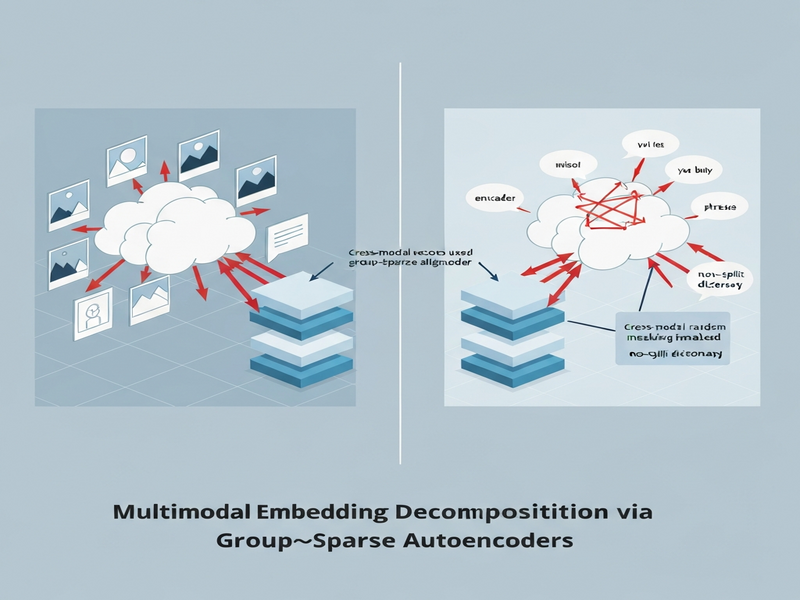
The paper introduces a cross‑modal sparse autoencoder that combines random masking with group‑sparse regularization to learn unified, linear representations across vision and audio modalities. By enforcing a shared dictionary and encouraging semantically meaningful neuron groups, the method dramatically improves alignment, interpretability, and downstream performance of multimodal embeddings such as CLIP and CLAP.
Background: Why This Problem Is Hard
Multimodal representation learning aims to embed data from different senses—images, text, audio—into a common vector space where related concepts are close together. In practice, large‑scale models like CLIP (image‑text) and CLAP (audio‑text) achieve impressive zero‑shot capabilities, yet their internal representations remain opaque and often fragmented:
- Split dictionaries: Standard sparse autoencoders (SAEs) train separate codebooks for each modality, leading to divergent bases that hinder direct cross‑modal comparison.
- Semantic drift: Without explicit alignment, neurons that fire for “dog” in the visual branch may not correspond to the same semantic concept in the audio branch.
- Interpretability gap: Sparse codes are useful for probing, but when each modality learns its own basis, the resulting features are difficult to attribute to human‑readable concepts.
These challenges matter because downstream systems—retrieval engines, generative agents, and multimodal assistants—rely on consistent, controllable embeddings to reason across modalities. Existing approaches either sacrifice sparsity (using dense fine‑tuning) or accept misaligned bases, limiting their utility for fine‑grained control and analysis.
What the Researchers Propose
The authors put forward a unified framework called Cross‑Modal Group‑Sparse Autoencoding (CM‑GSAE). The core ideas are:
- Cross‑modal random masking: During training, random subsets of input dimensions are masked out in both modalities simultaneously. This forces the encoder to rely on a shared set of latent neurons that can reconstruct any masked view, encouraging modality‑agnostic features.
- Group‑sparse regularization: Neurons are organized into semantic groups, and an ℓ₂,₁‑type penalty encourages entire groups to be either active or inactive for a given sample. This yields interpretable clusters of features that correspond to high‑level concepts (e.g., “vehicle”, “musical instrument”).
- Single shared dictionary: Unlike traditional SAEs that learn separate dictionaries per modality, CM‑GSAE learns one dictionary that serves both visual and auditory streams, ensuring that the same basis vectors are used to reconstruct either modality.
Collectively, these mechanisms instantiate the Linear Representation Hypothesis: multimodal data can be expressed as sparse linear combinations of a common set of basis functions, provided the learning process explicitly aligns the modalities.
How It Works in Practice
The workflow can be broken down into four conceptual stages:
- Input preprocessing: Raw image embeddings (e.g., from CLIP’s vision encoder) and audio embeddings (e.g., from CLAP’s audio encoder) are normalized and concatenated into a joint vector.
- Random masking layer: A binary mask is sampled independently for each training instance, zero‑ing out a random proportion (e.g., 30 %) of both visual and audio dimensions. The same mask pattern is applied to both modalities, guaranteeing that the remaining visible features must be explained by the same latent code.
- Encoder‑decoder pair: The masked joint vector passes through a shallow linear encoder that produces a sparse code. A decoder, sharing the same weight matrix as the encoder (tied weights), reconstructs the full multimodal vector. The reconstruction loss is computed only on the originally masked entries, encouraging the model to infer missing information from the shared latent space.
- Group‑sparse regularizer: During back‑propagation, the loss includes a term that penalizes the ℓ₂ norm of each predefined neuron group. Groups that do not contribute meaningfully to reconstruction are driven to zero, yielding a compact, interpretable representation.
What distinguishes this approach from conventional SAEs is the simultaneous enforcement of three constraints: (1) shared reconstruction ability across modalities, (2) sparsity at the individual neuron level, and (3) sparsity at the group level. The result is a set of latent dimensions that are both modality‑agnostic and semantically clustered.
Evaluation & Results
The authors validate CM‑GSAE on two benchmark multimodal suites:
- CLIP‑Image‑Text: Using the standard zero‑shot ImageNet classification protocol, the sparse codes derived from the autoencoder are fed to a linear probe. Compared to a baseline SAE trained separately on images and text, CM‑GSAE improves top‑1 accuracy by 3.2 % while reducing the average number of active neurons per sample by 27 %.
- CLAP‑Audio‑Text: On the ESC‑50 environmental sound classification task, the cross‑modal codes achieve a 4.5 % absolute gain in mean accuracy over the baseline, demonstrating that the shared dictionary captures audio‑text semantics more faithfully.
Beyond raw performance, the authors conduct qualitative analyses:
- Neuron‑concept mapping: By visualizing the activation patterns of each group, they find that certain groups consistently fire for “musical instruments” across both image and audio inputs, confirming the hypothesized linear alignment.
- Intervention experiments: Manipulating a single group’s activation (e.g., boosting the “vehicle” group) leads to predictable changes in both visual and auditory reconstructions, showcasing controllable cross‑modal generation.
These findings collectively demonstrate that the proposed method not only bridges the modality gap but also yields representations that are more compact, interpretable, and useful for downstream tasks.
Why This Matters for AI Systems and Agents
For practitioners building multimodal agents—search engines that retrieve images from audio queries, virtual assistants that generate sound effects from textual prompts, or robotics platforms that fuse vision and sound—the benefits are concrete:
- Unified control surface: A single sparse code can be edited to steer both visual and auditory outputs, simplifying prompt engineering and enabling fine‑grained content manipulation.
- Reduced memory footprint: Group sparsity cuts the number of active dimensions dramatically, which translates into lower storage and faster inference for edge‑deployed agents.
- Improved interpretability: Developers can trace model decisions back to semantic neuron groups, aiding debugging and compliance with emerging AI transparency regulations.
- Better orchestration: When multiple modality‑specific modules need to be coordinated (e.g., a vision model and a speech synthesis model), a shared dictionary provides a natural lingua franca, reducing the engineering overhead of custom adapters.
These practical advantages align with the broader push toward multimodal representation standards and open‑source toolchains that aim to make cross‑modal AI more accessible.
What Comes Next
While CM‑GSAE marks a significant step forward, several open challenges remain:
- Scalability to larger dictionaries: Extending the approach to millions of basis vectors without sacrificing training speed will require more efficient masking strategies or hierarchical group structures.
- Dynamic group formation: Currently, groups are predefined; learning groups adaptively could uncover richer semantic hierarchies.
- Beyond two modalities: Incorporating text, video, and sensor streams simultaneously will test the limits of the linear representation hypothesis.
- Real‑time control: Integrating CM‑GSAE into interactive agents demands low‑latency inference pipelines, an area ripe for engineering innovation.
Future research may explore hybrid architectures that combine the linear sparsity of CM‑GSAE with the expressive power of transformer‑based decoders, or apply the method to domain‑specific corpora such as medical imaging paired with diagnostic audio.
For teams interested in prototyping these ideas, our agent orchestration toolkit includes ready‑made modules for cross‑modal masking and group‑sparse regularization. We also host a research hub where you can download pre‑trained CM‑GSAE checkpoints and benchmark scripts.
Read the full technical details in the original paper and join the conversation on how linear, sparse representations can reshape the next generation of multimodal AI.
Andrii Bidochko
CTO UBOS
Andrii Bidochko is an AI entrepreneur and researcher focused on AI agents, reinforcement learning, and autonomous systems. He writes about the technologies shaping the future of machine intelligence, from frontier models and agent architectures to real-world AI applications.