

- Updated: January 24, 2026
- 6 min read
Agentic Persona Control and Task State Tracking for Realistic User Simulation in Interactive Scenarios
Direct Answer
The paper introduces a multi‑agent framework that combines agentic persona control with task state tracking to generate realistic, goal‑oriented user simulations for conversational AI testing. By decoupling persona generation, state management, and message attribute synthesis, the approach produces diverse, coherent interactions that better reflect real‑world user behavior, enabling more reliable evaluation of dialogue systems.
Background: Why This Problem Is Hard
Testing conversational agents—whether chatbots, voice assistants, or task‑oriented systems—requires user inputs that are both varied and contextually consistent. Traditional evaluation pipelines rely on static test sets or single‑LLM generators that suffer from two major shortcomings:
- Lack of persona fidelity: A single language model often collapses to a generic speaking style, failing to capture the nuances of different user personalities, cultural backgrounds, or expertise levels.
- State drift: When a conversation spans multiple turns, the model can lose track of the user’s goals, leading to contradictory or irrelevant responses that do not reflect realistic task progression.
These gaps limit the ability of developers to stress‑test dialogue policies, especially in complex, multi‑step scenarios such as booking travel, troubleshooting devices, or negotiating purchases. Moreover, the lack of controllable, reproducible user behavior hampers systematic A/B testing and hampers regulatory compliance where traceability of user interactions is required.
What the Researchers Propose
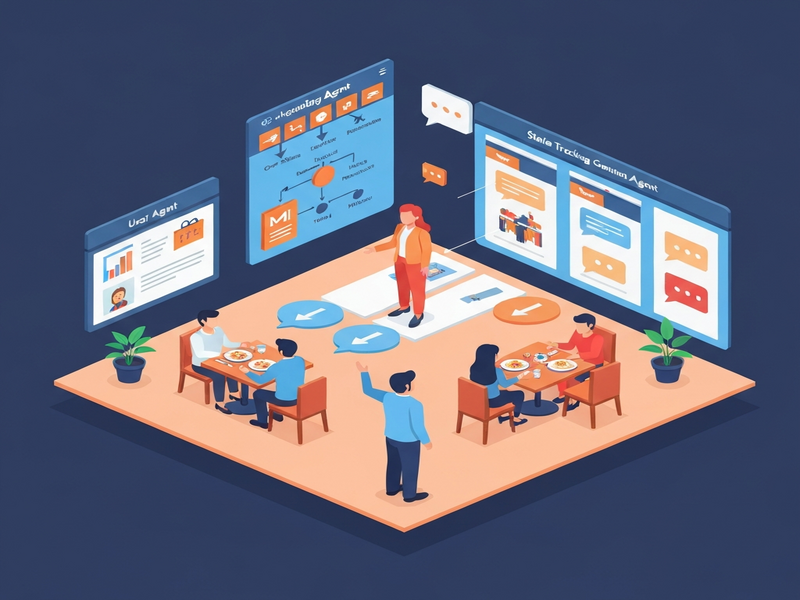
The authors present a modular multi‑agent architecture that separates the responsibilities of user simulation into three cooperating agents:
- User Persona Agent: Generates a consistent persona description (age, preferences, speaking style) and conditions all subsequent utterances on this profile.
- Task State Tracker Agent: Maintains a structured representation of the conversation’s goal state (e.g., items ordered, constraints, progress markers) and updates it after each turn.
- Message Attribute Generator Agent: Produces the actual textual response, conditioned on both the persona embedding and the current task state, while also injecting pragmatic attributes such as sentiment, formality, and intent tags.
By orchestrating these agents, the framework achieves two key capabilities:
- Fine‑grained control over user personality without sacrificing task relevance.
- Robust, interpretable state tracking that prevents goal drift and enables downstream analysis.
How It Works in Practice
The workflow proceeds in a turn‑based loop:
- Persona Initialization: The Persona Agent samples a persona from a predefined distribution (e.g., “college student who prefers vegan food, informal tone”). This persona vector is cached for the entire session.
- State Query: At each turn, the Task State Tracker receives the latest system utterance and updates its internal state graph (e.g., adding a new slot value or marking a sub‑task as completed).
- Message Synthesis: The Message Attribute Generator receives three inputs: the static persona embedding, the dynamic state snapshot, and the system’s last message. It then produces a user utterance that aligns with both the persona’s style and the current task requirements.
- Feedback Loop: The generated utterance is fed back to the conversational AI under test, and the cycle repeats until a terminal condition (task completion or timeout) is reached.
What distinguishes this approach from prior single‑LLM simulators is the explicit separation of concerns. Instead of overloading one model with persona, intent, and memory, each agent specializes, leading to higher fidelity in both style and logical consistency. The architecture also supports plug‑and‑play extensions: developers can swap in a more powerful LLM for the Message Generator while retaining the same persona and state modules.
Evaluation & Results
The authors validated the framework on a benchmark restaurant‑guest ordering scenario, a canonical task‑oriented dialogue domain. Evaluation comprised three dimensions:
- Persona Consistency: Human judges rated the alignment of simulated utterances with the assigned persona on a 5‑point Likert scale. The multi‑agent system achieved an average score of 4.3, compared to 2.9 for a baseline single‑LLM generator.
- Task Success Rate: The simulated users successfully completed the ordering process (selecting dishes, specifying dietary restrictions, confirming the order) in 92% of dialogues, versus 68% for the baseline.
- State Fidelity: A post‑hoc analysis measured the divergence between the intended task state and the state inferred from the simulated utterances. The multi‑agent approach exhibited a mean absolute error of 0.12, substantially lower than the baseline’s 0.35.
Additional ablation studies demonstrated that removing the State Tracker caused a 23% drop in task success, while disabling persona conditioning reduced consistency scores by 1.4 points. These results underscore the complementary nature of the three agents and validate the claim that realistic user simulation requires both persona control and explicit state management.
Why This Matters for AI Systems and Agents
For practitioners building conversational AI, the framework offers a practical pathway to more rigorous testing:
- Improved Evaluation Accuracy: By exposing dialogue policies to a spectrum of realistic user behaviors, developers can surface edge‑case failures that static test sets miss.
- Accelerated Development Cycles: Automated, high‑fidelity simulations reduce reliance on costly human user studies, enabling rapid iteration on model updates.
- Regulatory Compliance: Structured state logs provide traceable evidence of how a system handles user intents, supporting audits for privacy and safety standards.
- Scalable Persona Libraries: Organizations can curate persona catalogs reflecting target demographics, ensuring that products are evaluated against the right user segments.
These capabilities align with the growing demand for trustworthy, user‑centric AI, especially in sectors like finance, healthcare, and e‑commerce where conversational agents must navigate complex, high‑stakes interactions. For teams looking to adopt this technology, UBOS’s agentic simulation platform provides an out‑of‑the‑box implementation that integrates seamlessly with existing dialogue pipelines.
What Comes Next
While the presented framework marks a significant step forward, several avenues remain open for exploration:
- Cross‑Domain Generalization: Extending the persona‑state architecture to domains beyond restaurant ordering, such as technical support or multi‑modal interactions.
- Dynamic Persona Evolution: Allowing personas to adapt over time based on interaction history, mirroring real users whose preferences shift.
- Hybrid Human‑in‑the‑Loop Simulations: Combining automated agents with occasional human interventions to capture rare edge cases.
- Evaluation Standardization: Developing community benchmarks that incorporate persona diversity and state fidelity as core metrics.
Future research could also investigate tighter integration with reinforcement learning agents, enabling simulated users to provide reward signals that reflect nuanced human satisfaction. For organizations interested in pioneering these directions, UBOS’s roadmap for user simulation outlines collaborative opportunities and upcoming tool releases.
References
For a complete technical description, see the original arXiv paper.
Andrii Bidochko
CTO UBOS
Andrii Bidochko is an AI entrepreneur and researcher focused on AI agents, reinforcement learning, and autonomous systems. He writes about the technologies shaping the future of machine intelligence, from frontier models and agent architectures to real-world AI applications.